LangGraph vs AutoGen (2026): Pick the Right Agent Framework
LangGraph vs AutoGen compared - graph-based state control vs conversation-driven multi-agent collaboration, the Microsoft Agent Framework shift, deployment, cost, and a clear verdict for 2026.
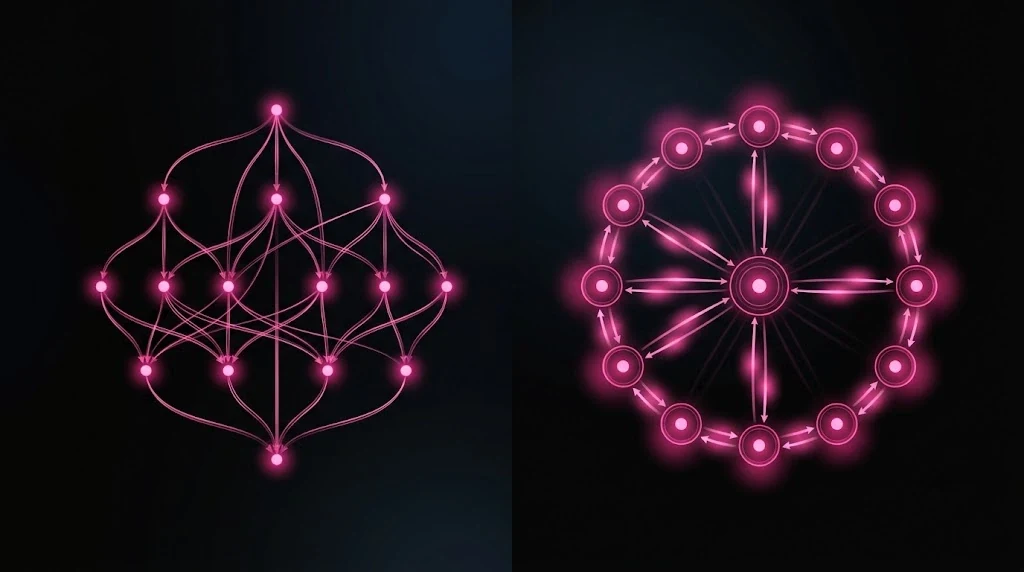
Choosing between LangGraph and AutoGen is one of the first real decisions teams face when they move from a single LLM call to a multi-step agent. This post compares them head to head. For the layer below - retrieval and data orchestration - see our LangChain vs LlamaIndex comparison.
The short answer
- LangGraph - a low-level framework from the LangChain team for building stateful, controllable agents as graphs (nodes, edges, cyclic flows). Pick it when you need explicit control over state and flow, durable checkpointing, and reliable human-in-the-loop steps.
- AutoGen - a multi-agent framework from Microsoft Research where agents converse to solve tasks (conversable agents, group chat, tool and code execution). Pick it when your problem is naturally solved by several agents talking and coordinating.
- Both - use LangGraph as the durable outer orchestrator and run AutoGen-style multi-agent conversation inside a node where collaboration genuinely helps.
The rest of this post goes deep on when each wins, plus the 2026 Microsoft Agent Framework shift you need to factor in.
Deciding factor to pick
| Your deciding factor | Pick |
|---|---|
| You need explicit control over state and execution flow | LangGraph |
| Your problem is naturally several agents conversing and negotiating | AutoGen |
| You need durable checkpointing, pause/resume, and time-travel debugging | LangGraph |
| You want a research-friendly multi-agent chat and group-chat abstraction | AutoGen |
| You are standardizing on the LangChain + LangSmith ecosystem | LangGraph |
| You are building on the Microsoft and Azure stack | AutoGen (and evaluate the Microsoft Agent Framework) |
| You need tightly scoped, native human-in-the-loop approval gates | LangGraph |
| You want agents that autonomously run code and tools to reach consensus | AutoGen |
Rule of thumb: if the hard part is controlling state and flow, choose LangGraph; if the hard part is getting agents to collaborate, choose AutoGen.
What each tool is
- LangGraph is a low-level orchestration framework from the LangChain team for building stateful, controllable agent applications as graphs of nodes and edges. It supports cyclic flows (agents that loop until done), built-in persistence and checkpointing, native human-in-the-loop, and streaming. It pairs with LangSmith for observability and LangGraph Platform for managed deployment.
- AutoGen is a multi-agent framework from Microsoft Research in which agents converse to solve tasks - conversable agents, group chat, and tool/code execution. It was re-architected in v0.4 (January 2025) into an async, event-driven actor model with a three-layer API (autogen-core, autogen-agentchat, autogen-ext). In 2025, Microsoft converged AutoGen and Semantic Kernel into the new Microsoft Agent Framework.
LangGraph vs AutoGen: head-to-head
| Dimension | LangGraph | AutoGen |
|---|---|---|
| Maintainer | LangChain | Microsoft Research |
| Core model | Graph (nodes, edges, cyclic flows) | Conversation (agents that talk) |
| Primary strength | Explicit state and flow control | Multi-agent collaboration |
| State and persistence | Built-in checkpointing, pause/resume, time-travel | Async state via actor runtime |
| Human-in-the-loop | Native, fine-grained gates | Supported, less granular |
| Multi-agent style | Graph nodes (any topology you draw) | Conversable agents, group chat |
| Runtime (v0.4 onward) | Graph execution engine | Async, event-driven actor model |
| Observability | LangSmith (first-party) | OpenTelemetry, Azure tooling |
| Managed deployment | LangGraph Platform | Azure AI Foundry |
| Determinism / auditability | High (explicit edges) | Lower (emergent conversation) |
| Ecosystem | LangChain, LangSmith | Microsoft, Azure, Semantic Kernel |
| 2026 roadmap note | Actively developed standalone | Converging into Microsoft Agent Framework |
| License | MIT | MIT |
When to choose LangGraph
Pick LangGraph when:
- Control over state and flow is the hard part. You want to draw the exact execution graph - which node runs when, which edges are conditional, where the loops are.
- You need durable, recoverable state. Built-in checkpointing lets you pause, resume, recover from failures, and even time-travel to a prior step for debugging.
- Human-in-the-loop gates are required. Approval steps, manual edits, and interrupts are first-class, which matters for regulated or high-stakes workflows.
- You are already in the LangChain ecosystem. LangSmith for tracing and LangGraph Platform for deployment slot in with no glue code.
- Auditability matters. Explicit edges make the agent’s behavior far easier to reason about and review than emergent conversation.
- You are building a complex single-or-multi-agent workflow that must behave the same way every run.
When to choose AutoGen
Pick AutoGen when:
- Your problem is naturally a conversation. Several specialized agents (planner, coder, critic, executor) that talk, critique, and hand off work map cleanly onto AutoGen’s model.
- You want multi-agent collaboration out of the box. Conversable agents and group chat give you coordination patterns without wiring a graph by hand.
- Agents need to run tools and code autonomously. AutoGen’s code/tool execution loop is a core strength for agents that build and verify their own work.
- You are on the Microsoft and Azure stack. AutoGen aligns with Azure AI Foundry and the broader Microsoft agent tooling.
- You want an async, event-driven foundation. The v0.4 actor-model rewrite is built for scale, observability, and flexible collaboration patterns.
- You are prototyping multi-agent research ideas where emergent behavior is the point, not a risk.
Can you use them together?
Yes, and it is a strong pattern when you want AutoGen-style collaboration under LangGraph-style control. The topology we deploy:
- LangGraph is the durable outer orchestrator. It owns state, checkpoints, retries, and human approval gates for the end-to-end workflow.
- A multi-agent conversation lives inside one node. For the part of the workflow that genuinely benefits from agents debating - say, a planner-coder-critic loop - run AutoGen (or an AutoGen-style conversable pattern) inside a single LangGraph node.
- LangGraph captures, persists, and continues. The conversation returns a result, LangGraph checkpoints it, and the deterministic flow carries on.
This gives you collaboration where it helps and auditability everywhere else. The same agents will need guardrails on their inputs and outputs regardless of which framework orchestrates them.
Cost comparison
Both core libraries are open source and free to self-host - the real spend is LLM tokens, which scale with how many agent turns and tool calls your system generates.
- LangGraph the library is free (MIT). LangChain monetizes the surrounding platform: LangGraph Platform for managed deployment and scaling, and LangSmith for observability, both paid products with their own plans. Multi-step graphs with loops are the main token cost.
- AutoGen the library is free (MIT). On the Microsoft side, managed orchestration runs through Azure AI Foundry Agent Service, billed as an Azure service. Multi-agent conversation is inherently chattier, so uncapped group chats can run up token cost fast.
The practical lesson for both: cap turns, scope loops tightly, and watch multi-agent chatter, because emergent conversation is where token bills quietly balloon.
Common pitfalls
- Forcing a conversation into a graph (or vice versa). If the hard part is collaboration, fighting AutoGen’s model with rigid edges is painful; if you need determinism, hoping an AutoGen group chat converges reliably will burn you.
- Ignoring the Microsoft Agent Framework shift. Starting net-new standalone AutoGen code in 2026 without weighing MAF (AutoGen and Semantic Kernel are in maintenance mode) risks building on a frozen base.
- Uncapped multi-agent loops. Both frameworks will happily loop forever - set turn limits, recursion caps, and budget guards or you will get runaway token bills and stuck agents.
- Skipping persistence in LangGraph. Teams adopt LangGraph and then never configure a checkpointer, throwing away its biggest advantage - durable, resumable state.
- No safety testing on tool use. Agents that run code and call tools need adversarial testing for excessive agency and prompt injection before production, whichever framework you choose.
Related reading
- LangChain vs LlamaIndex (2026) - the retrieval and data-orchestration layer beneath your agents
- Guardrails AI vs NeMo Guardrails (2026) - the safety layer that wraps agent inputs and outputs
LangGraph and AutoGen orchestrate how your agents behave. When a failure points at the underlying model rather than the flow, take it down a layer to model validation and ML model QA at aiml.qa.
Getting help
We help Series A-C AI startups choose between LangGraph, AutoGen, and the Microsoft Agent Framework, then build the QA and safety practice that keeps those agents reliable in production. A genai.qa Agentic AI Safety Assessment covers framework selection, flow correctness, and adversarial testing for excessive agency and unsafe tool use.
Frequently Asked Questions
LangGraph vs AutoGen: which should I use?
Use LangGraph when you need explicit, reliable control over an agent's state and flow - it models your application as a graph of nodes and edges with built-in persistence, checkpointing, and human-in-the-loop pauses, which makes complex single-or-multi-agent workflows predictable and debuggable. Use AutoGen when your problem is naturally solved by several agents talking to each other - it is conversation-driven and shines at multi-agent collaboration where roles negotiate, critique, and hand off work. Neither is universally better; LangGraph optimizes for control, AutoGen optimizes for collaboration. For production systems that need both auditability and multi-agent coordination, many teams pick LangGraph as the orchestration backbone and borrow AutoGen-style conversation patterns inside it.
Is AutoGen a good LangGraph alternative?
AutoGen is a partial alternative with a different philosophy. It replaces LangGraph if your core need is multi-agent conversation - agents that converse, run tools and code, and reach consensus - and you do not need the fine-grained graph-level control LangGraph gives you. It is a weaker substitute when you need deterministic flow control, durable checkpointing, and tightly scoped human-in-the-loop gates, which are LangGraph's strengths. One important note for 2026: Microsoft has folded AutoGen and Semantic Kernel into the new Microsoft Agent Framework, so new AutoGen projects should weigh that roadmap. See the head-to-head below before deciding.
What is the Microsoft Agent Framework and how does it affect AutoGen?
Microsoft Agent Framework (MAF) launched in public preview on October 1, 2025 and converges two Microsoft lineages - AutoGen (the multi-agent research framework) and Semantic Kernel (the production SDK) - into one platform for Python and .NET. Microsoft has stated that AutoGen and Semantic Kernel have entered maintenance mode, with future development centered on MAF. AutoGen's ideas (conversational multi-agent orchestration, the async event-driven core from v0.4) live on inside MAF alongside Semantic Kernel's enterprise plumbing. If you are starting fresh on the Microsoft stack today, evaluate MAF directly rather than committing net-new code to standalone AutoGen.
How do LangGraph and AutoGen handle deployment and persistence?
LangGraph has first-class persistence built in: checkpointers save graph state after every step, so you can pause, resume, time-travel, and recover from failures, and human-in-the-loop steps are native. For hosting, LangChain offers LangGraph Platform (managed deployment, scaling, and a visual studio) and LangSmith for tracing and observability. AutoGen v0.4 rewrote its foundation as an async, event-driven actor model with autogen-core, autogen-agentchat, and autogen-ext layers, and ships OpenTelemetry-based observability; production deployment on the Microsoft stack increasingly runs through Azure AI Foundry and, going forward, the Microsoft Agent Framework. In short, LangGraph bakes durable state into the framework, while AutoGen leans on the surrounding Microsoft and Azure ecosystem for production hosting.
How much do LangGraph and AutoGen cost?
Both core libraries are open source and free to install and self-host - your real spend is LLM API tokens, which scale with how many agent turns and tool calls your graphs or conversations generate. LangGraph the library is free; LangGraph Platform (managed deployment) and LangSmith (observability) are paid LangChain products with their own plans. AutoGen the library is free; on the Microsoft side, managed orchestration runs through Azure AI Foundry Agent Service, which is billed as an Azure service. The biggest cost driver for both is token consumption from multi-step reasoning and multi-agent chatter, so design tight loops and cap turns to control spend.
Can I use LangGraph and AutoGen together?
Yes, and it is a sensible pattern when you want AutoGen-style multi-agent conversation under LangGraph-style control. A common topology is to use LangGraph as the durable outer orchestrator - it owns state, checkpoints, retries, and human approval gates - and to run a multi-agent conversation (modeled on AutoGen's conversable-agent pattern, or AutoGen itself wrapped as a node) inside a single graph node for the part of the workflow that genuinely benefits from agents debating. LangGraph then captures the result, persists it, and continues the deterministic flow. This gives you AutoGen's collaboration where it helps and LangGraph's auditability everywhere else.
Complementary NomadX Services
Related Comparisons
Break It Before They Do.
Book a free 30-minute GenAI QA scope call. We review your AI application, identify the top risks, and show you exactly what to test before you ship.
Talk to an Expert